

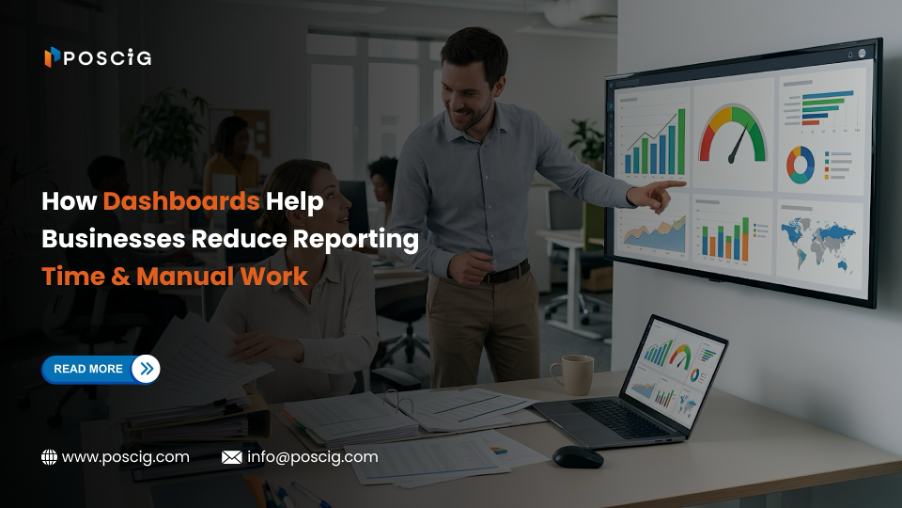
In today’s data-driven business environment, organizations rely on information from multiple systems, including CRM platforms, accounting software, marketing tools, ERP solutions, and customer service applications. While data is essential for decision-making, many businesses still spend countless hours collecting, organizing, and preparing reports manually.
The result? Delayed insights, increased operational costs, and reduced productivity.
Modern business dashboards solve these challenges by automating reporting processes, centralizing data, and providing real-time visibility into business performance. Instead of spending hours building reports, teams can focus on analyzing insights and making strategic decisions.
In this blog, we’ll explore how dashboards help businesses reduce reporting time, eliminate manual work, and improve overall efficiency.
What Is a Business Dashboard?
A business dashboard is a visual interface that consolidates data from multiple sources and presents key metrics, KPIs, and performance indicators in one centralized location.
Rather than navigating multiple spreadsheets or software applications, decision-makers can access critical information through interactive charts, graphs, and reports.
Business dashboards automate data collection, reporting, and visualization, helping organizations reduce manual work, improve accuracy, and make faster data-driven decisions.
Why Traditional Reporting Is No Longer Sustainable
Many organizations still rely heavily on spreadsheets and manual reporting processes. While this approach may work initially, it becomes increasingly inefficient as data volumes grow.
Common Challenges of Manual Reporting
Time-Consuming Data Collection
Employees often spend hours gathering information from different platforms before creating reports.
Increased Risk of Human Error
Manual data entry and spreadsheet management can lead to inaccuracies that affect business decisions.
Delayed Decision-Making
Reports are often generated weekly or monthly, meaning leadership teams are making decisions based on outdated information.
Lack of Real-Time Visibility
Businesses struggle to identify issues or opportunities quickly when performance data is not readily available.
Reduced Employee Productivity
Highly skilled professionals spend valuable time creating reports instead of focusing on business growth and innovation.
How Dashboards Reduce Reporting Time
1. Automated Data Integration
Business dashboards connect directly with multiple systems and automatically collect data from various sources.
This eliminates the need to manually export, combine, and format information from different platforms.
Benefit: Saves hours of repetitive work every week.
2. Real-Time Reporting
Traditional reporting often involves waiting days or weeks for updated reports.
Dashboards provide instant access to live business data, allowing stakeholders to monitor performance as it happens.
Examples include:
- Sales performance
- Revenue trends
- Marketing campaign results
- Customer acquisition metrics
- Operational KPIs
Benefit: Faster and more informed decision-making.
3. Instant Report Generation
With dashboard solutions, reports are automatically updated and available whenever needed.
Executives and managers no longer need to request reports from analysts or spend time building them manually.
Benefit: Significant reduction in report preparation time.
4. Centralized Data Access
Instead of searching through multiple spreadsheets and systems, dashboards provide a single source of truth.
Teams can access all critical information from one platform.
Benefit: Improved efficiency and collaboration across departments.
5. Automated KPI Monitoring
Dashboards continuously track key performance indicators without manual calculations.
Metrics such as:
- Revenue Growth
- Customer Retention Rate
- Conversion Rate
- Project Performance
- Employee Productivity
are updated automatically.
Benefit: More accurate performance tracking with minimal effort.
Key Business Benefits of Dashboard Solutions
Faster Decision-Making
Real-time insights allow organizations to respond quickly to changing market conditions.
Improved Productivity
Employees spend less time gathering data and more time driving business outcomes.
Better Data Accuracy
Automation minimizes errors caused by manual data entry and spreadsheet management.
Enhanced Business Visibility
Leadership teams gain a comprehensive view of organizational performance.
Reduced Operational Costs
Less time spent on reporting translates into lower administrative costs and greater efficiency.
Scalable Reporting Infrastructure
As businesses grow, dashboards can handle increasing volumes of data without increasing reporting workloads.
Industries That Benefit Most From Business Dashboards
Dashboard reporting and business intelligence solutions deliver value across various sectors.
Financial Services
Track profitability, budgets, forecasts, and compliance metrics.
Healthcare
Monitor patient data, operational efficiency, and resource utilization.
Retail & E-Commerce
Analyze sales trends, customer behavior, and inventory performance.
Manufacturing
Track production efficiency, supply chain performance, and equipment utilization.
Logistics & Transportation
Monitor delivery performance, fleet operations, and operational KPIs.
Technology Companies
Track project progress, development performance, and business growth metrics.
Why Businesses Are Investing in Business Intelligence Dashboards
Organizations are under increasing pressure to make faster and smarter decisions.
Modern dashboard solutions help businesses:
✔ Reduce reporting time by up to several hours per week
✔ Eliminate repetitive manual tasks
✔ Improve data accuracy
✔ Increase operational efficiency
✔ Gain real-time business visibility
✔ Support data-driven decision-making
Companies that embrace Business Intelligence (BI) solutions are better equipped to adapt, grow, and compete in today’s fast-moving marketplace.
FAQs
Dashboards automate data collection and report generation, eliminating manual reporting processes and providing instant access to business insights.
Yes. Modern dashboards centralize data, automate reporting, and significantly reduce reliance on spreadsheets.
Automated reporting improves accuracy, saves time, reduces manual work, and provides real-time visibility into business performance.
Absolutely. Businesses of all sizes can benefit from automated reporting and real-time performance monitoring.
Sales, marketing, finance, operations, customer service, and executive leadership teams all benefit from dashboard-driven insights.
Conclusion
Manual reporting consumes valuable time, increases the risk of errors, and slows business decision-making. As organizations continue to generate more data, traditional reporting methods become increasingly inefficient.
Business dashboards solve these challenges by automating data collection, centralizing information, and delivering real-time insights that drive smarter decisions.
Instead of spending hours building reports, your team can focus on what truly matters growing the business.
Ready to Transform Your Reporting Process?
Poscig Technologies helps businesses build powerful Business Intelligence dashboards that automate reporting, reduce manual work, and provide actionable insights.
Schedule a consultation today and discover how intelligent dashboard solutions can help your organization work smarter and make better decisions faster.

Error: Contact form not found.