
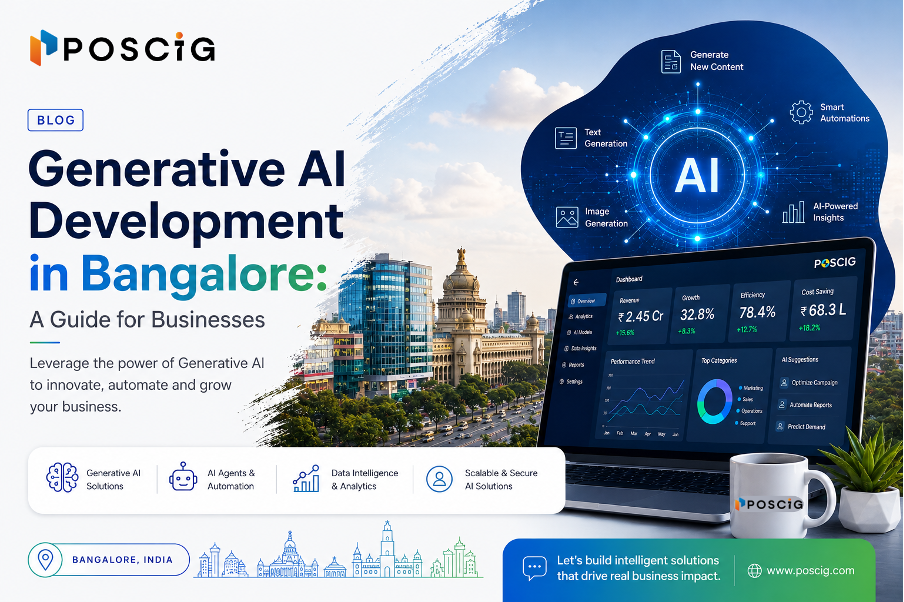
Bangalore is India’s leading hub for generative AI development, home to over 150 GenAI startups and hundreds of enterprise AI teams. Businesses typically engage Bangalore-based generative AI developers either through dedicated development agencies, freelance/contract talent, or in-house hiring with agency engagements ranging roughly from $25–$80 per developer hour depending on scope, seniority, and specialization (custom LLM fine-tuning, RAG pipelines, AI agents, or generative content tools).
If you’re evaluating whether and how to build generative AI capability in Bangalore, this guide breaks down the ecosystem, costs, engagement models, and what to look for in a development partner.
Why Bangalore Is a Hub for Generative AI Development
Bangalore (Bengaluru) has become India’s default city for AI talent and company formation, for a few concrete reasons:
- Talent density: The city hosts the largest concentration of AI/ML engineers in India, feeding from IITs, IISc, and a mature IT services base built over three decades.
- Startup ecosystem scale: Bengaluru is home to more than 150 active generative AI startups — the largest concentration in India — spanning healthcare AI, legal tech, developer tools, and enterprise automation.
- Capital availability: Generative AI companies headquartered in the city have collectively raised close to $1 billion to date, signaling investor confidence and a deep pool of experienced, previously-funded engineering teams.
- Enterprise presence: Global technology companies and GCCs (Global Capability Centers) run AI R&D out of Bangalore, which trains a continuous pipeline of engineers who later move into startups and consultancies.
- Cost efficiency: Development costs remain substantially lower than the US, UK, or Western Europe, without a proportional drop in technical quality — a major reason international businesses source GenAI development from the city.
What "Generative AI Development" Actually Covers
| Service Area | What It Involves |
|---|---|
| Custom LLM fine-tuning | Adapting foundation models (GPT, Claude, Llama, Gemini) to a company's data and tone. |
| RAG (Retrieval-Augmented Generation) | Connecting LLMs to internal knowledge bases for accurate, grounded responses. |
| AI agents & automation | Building multi-step autonomous agents for tasks like customer support, research, or workflow automation. |
| Generative content tools | Text, image, video, or code generation products for internal or customer-facing use. |
| AI-powered chatbots & assistants | Conversational interfaces layered on business data and APIs. |
| MLOps & deployment | Model hosting, monitoring, evaluation, and cost optimization at scale. |
| Industry-specific GenAI | Vertical solutions for healthcare (diagnostics, documentation), legal (contract review), fintech (fraud detection, reporting), and e-commerce (personalization). |
How to Engage Generative AI Talent in Bangalore
Businesses generally choose from three models:
1. Dedicated AI Development Agencies
Full-service firms that scope, build, and maintain GenAI products end-to-end. Best for businesses without an internal AI team, or those that need to move fast on a defined use case.
2. Staff Augmentation / Dedicated Teams
Hiring individual AI engineers or a dedicated pod that works as an extension of your in-house team, typically on a monthly retainer. Best for companies with existing product/engineering leadership who need specialized GenAI skill they lack internally.
3. In-House Hiring
Building a permanent internal team. Best for companies where AI is core to the long-term product roadmap and requires deep, ongoing institutional knowledge.
A rough guide to choosing:
- Need a working prototype or MVP fast → agency
- Need to scale an existing product with AI features → staff augmentation
- AI is your core product → in-house team, often supplemented by an agency for specialized work
What Drives the Cost of GenAI Development in Bangalore
Pricing varies widely based on:
- Model complexity — using an existing foundation model via API costs far less than training or heavily fine-tuning a custom model
- Data readiness — clean, structured, accessible data reduces engineering time significantly; messy or siloed data adds cost
- Integration scope — connecting AI outputs to existing systems (CRM, ERP, internal tools) typically takes longer than standalone builds
- Compliance requirements — healthcare, finance, and legal use cases require additional guardrails, audit trails, and testing
- Ongoing maintenance — GenAI systems need monitoring for model drift, cost control, and output quality, which is often underestimated in initial budgets
Common Generative AI Use Cases Businesses Are Building in Bangalore
- Customer support automation — AI agents that resolve tier-1 queries and escalate intelligently
- Sales enablement — AI tools that draft outreach, summarize calls, and score leads
- Content operations — generative tools for marketing copy, product descriptions, and localization
- Internal knowledge assistants — RAG-based tools that let employees query company documentation in natural language
- Document processing — automated extraction and summarization for contracts, invoices, and reports
- Healthcare AI — diagnostic support, synthetic medical imaging, and clinical documentation assistance, an area where Bangalore-based firms have particularly strong depth
How to Evaluate a Generative AI Development Partner
When shortlisting a Bangalore-based team or agency, ask:
- Can they show production systems, not just demos? A working prototype in a sandbox is very different from a GenAI feature running reliably at scale.
- Do they have experience with your specific model stack? Fine-tuning open-source models (Llama, Mistral) requires different expertise than building on top of closed APIs (GPT, Claude, Gemini).
- How do they handle data privacy and security? Ask specifically how customer data is handled during fine-tuning or RAG indexing, and whether they support private/on-prem deployment if needed.
- What’s their approach to evaluation? Serious teams measure output quality (accuracy, hallucination rate, latency, cost per query) rather than shipping and hoping.
- What does post-launch support look like? GenAI products need iteration as models and usage patterns evolve — check whether ongoing maintenance is part of the engagement.
Faq's
Is Bangalore a good place to outsource generative AI development?
Yes. Bangalore has the largest concentration of AI engineering talent in India, a mature ecosystem of GenAI startups and agencies, and significantly lower development costs than the US or Western Europe, making it a common choice for both Indian and international businesses.
How much does generative AI development cost in Bangalore?
Costs vary by scope and complexity, but Bangalore-based development is generally priced well below US and UK market rates for comparable work, with pricing driven primarily by model complexity, data readiness, and integration requirements rather than location alone.
What's the difference between hiring an agency vs. an in-house AI team in Bangalore?
Agencies suit businesses that need a defined product built quickly without maintaining a permanent AI function. In-house teams suit businesses where generative AI is a core, ongoing part of the product. Many companies start with an agency and transition to an in-house team as the use case matures.
Can small businesses use generative AI, or is it only for large enterprises?
Small businesses are increasingly using generative AI for practical tasks like customer query handling, marketing content generation, and internal reporting these don’t require custom model training and can be built cost-effectively on top of existing foundation models.
What industries is Bangalore's GenAI ecosystem strongest in?
Healthcare AI, legal tech, developer tools, enterprise automation, and fintech are particularly well-represented among Bangalore’s generative AI companies, giving businesses in these sectors access to teams with direct domain experience.
Key Takeaway
Bangalore offers businesses a rare combination: deep, proven AI engineering talent, a competitive cost structure, and a dense ecosystem of specialized companies across nearly every GenAI use case. The right approach depends less on the city and more on matching your engagement model agency, staff augmentation, or in-house to how central generative AI is to your business, and vetting partners on production experience rather than demos alone.
Generative AI is only as useful as the data and dashboards feeding it most GenAI use cases, from AI agents to automated reporting, ultimately surface through a dashboard that decision-makers actually use. For businesses in Saudi Arabia looking to pair their AI initiatives with strong analytics and dashboard infrastructure, Poscig provides dedicated dashboard development services built for exactly this kind of data-driven decision-making turning raw and AI-generated insights into clear, actionable, real-time views for your team.