

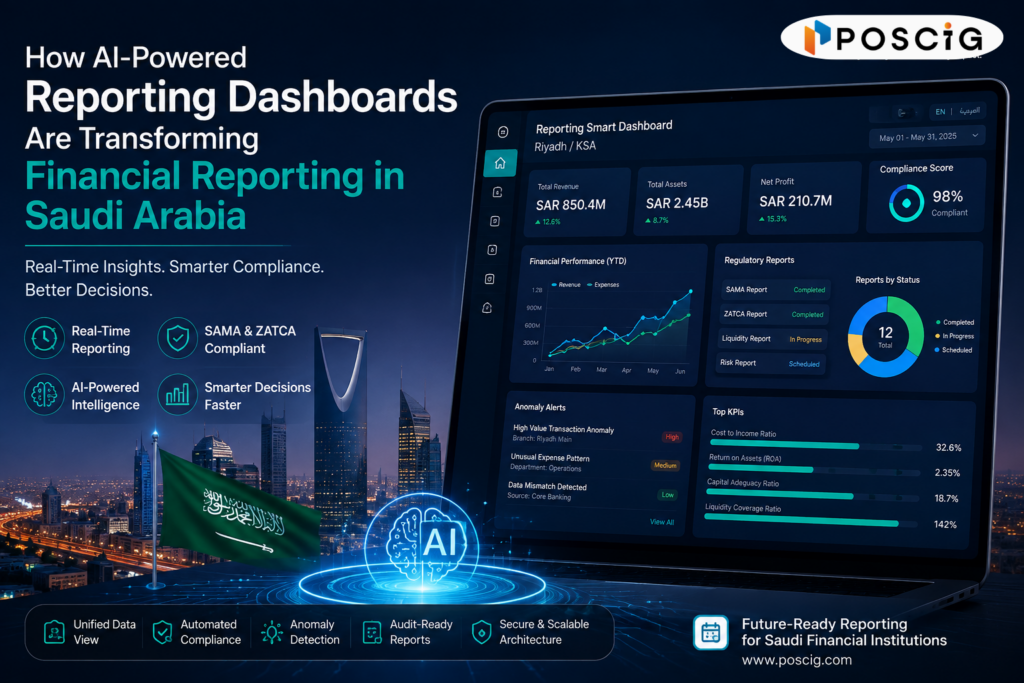
Financial institutions in Saudi Arabia are managing increasingly complex data across banking platforms, lending systems, compliance applications, finance operations and risk-management functions. As reporting volumes grow, relying on disconnected spreadsheets and manually consolidated reports can make it harder for teams to obtain timely, consistent and traceable information.
This is where AI-powered reporting dashboards are becoming increasingly valuable.
An AI-powered reporting dashboard can bring data from multiple financial and operational systems into a centralized reporting environment, helping teams monitor key metrics, identify anomalies, automate reporting workflows and make decisions using more current information.
For banks, NBFCs, fintechs and other financial institutions in Riyadh and across the Kingdom of Saudi Arabia (KSA), the opportunity is not simply to replace spreadsheets with visual dashboards. The bigger opportunity is to create a governed reporting layer that supports regulatory reporting, risk visibility, audit readiness and faster decision-making.
POSCIG AI’s Reporting Smart Dashboard is designed around this approach, using an agentic AI-powered reporting layer to consolidate, validate and visualize information from banking, lending and compliance systems.
What Is an AI-Powered Reporting Dashboard?
An AI-powered reporting dashboard is a reporting system that combines data integration, analytics, automation and artificial intelligence to provide organizations with a centralized view of business and financial information.
Unlike a traditional dashboard that primarily visualizes already-prepared data, an intelligent reporting dashboard can help with activities such as:
- Consolidating data from multiple systems
- Validating reporting data
- Identifying anomalies and exceptions
- Monitoring financial and operational KPIs
- Automating recurring reports
- Supporting regulatory reporting workflows
- Maintaining report versions and audit trails
- Providing role-specific information
- Generating insights for faster decision-making
For Saudi financial institutions, these capabilities can become particularly valuable when reporting requirements involve multiple stakeholders, data sources and control processes.
SAMA’s reporting requirements, for example, require banks to maintain internal systems supporting group-wide risk monitoring and reporting and to provide information when required by the regulator.
Why Financial Reporting Is Changing in Saudi Arabia
Saudi Arabia’s financial sector is undergoing significant digital transformation. As institutions expand digital lending, payments, banking and fintech operations, the volume and variety of data that finance, compliance and risk teams need to monitor also increases.
At the same time, financial institutions must manage requirements related to:
- Regulatory reporting
- Risk monitoring
- Data governance
- Data protection
- Internal controls
- Auditability
- Cybersecurity
- Operational efficiency
SAMA’s regulatory framework includes dedicated areas covering reporting requirements, IT governance, data privacy, cyber risk and risk management.
SAMA also emphasizes the protection and secure handling of customer personal data and requires financial institutions to maintain appropriate policies, procedures and controls around data protection.
This creates a strong need for reporting environments where data is not only visible, but also controlled, traceable and actionable.
7 Ways AI-Powered Reporting Dashboards Are Transforming Financial Reporting
1. Moving From Manual Reporting to Real-Time Visibility
Traditional reporting processes often involve collecting data from different systems, exporting spreadsheets, checking formulas, consolidating information and preparing reports manually.
This creates delays and increases the possibility of inconsistencies.
An AI-powered reporting dashboard can connect data from systems such as:
- Core banking platforms
- Loan origination systems (LOS)
- Loan management systems (LMS)
- Compliance systems
- Finance platforms
- Operational databases
POSCIG AI’s Reporting Smart Dashboard is designed to consolidate these sources into a single governed reporting view.
Instead of waiting for a reporting cycle to complete, finance and management teams can work from a more current view of their data.
Business impact: Faster access to financial information can support quicker management decisions and reduce dependency on manually consolidated spreadsheets.
2. Automating Regulatory Reporting Workflows
Regulatory reporting can involve repetitive data preparation, validation, formatting and review.
AI-powered reporting platforms can help automate parts of this workflow by connecting source data with predefined reporting structures and validation processes.
For Saudi financial institutions, this can support reporting workflows aligned with applicable SAMA requirements and other relevant regulatory processes.
POSCIG AI’s solution is positioned to generate SAMA-aligned and ZATCA-ready reports, reducing the need for manual reformatting.
Importantly, a technology platform does not itself replace an institution’s regulatory responsibilities. Actual compliance depends on the institution’s configuration, controls, governance and applicable regulatory requirements.
3. Detecting Data Anomalies Before They Become Reporting Problems
One of the biggest advantages of AI-assisted reporting is the ability to identify unusual patterns and exceptions.
For example, an intelligent reporting system can help surface:
- Unexpected changes in financial figures
- Data mismatches between systems
- Unusual transaction patterns
- Missing information
- Reporting inconsistencies
- KPI deviations
- Exceptions requiring investigation
POSCIG AI’s Reporting Smart Dashboard uses agentic AI to flag anomalies and exceptions before they reach auditors or become part of a reporting workflow.
This shifts reporting from a reactive process toward a more proactive approach.
Instead of discovering a problem after a report has been generated, teams can investigate exceptions earlier.
4. Creating Audit-Ready Reporting Environments
Audit and compliance teams need more than attractive charts.
They need to understand:
Where did the number come from?
When was it generated?
Which version was used?
What changed?
This is why auditability is an important part of modern reporting architecture.
POSCIG AI’s dashboard includes an audit-trail approach in which reports are designed to be traceable, versioned and export-ready for regulatory review.
This can help organizations create a clearer connection between source data, reporting outputs and review processes.
5. Giving Different Teams the Information They Actually Need
A CFO does not necessarily need the same dashboard as a compliance officer.
Similarly:
- Risk teams need risk indicators.
- Finance teams need financial KPIs.
- Compliance teams need regulatory reporting visibility.
- Auditors need traceability.
- Senior management needs summarized business performance.
- Boards need high-level strategic metrics.
A smart reporting environment can provide role-based dashboards so each stakeholder sees the information most relevant to their responsibilities.
POSCIG AI specifically positions role-based dashboards for compliance officers, CFOs, risk teams and boards.
This can reduce information overload while improving decision-making visibility.
6. Supporting Arabic and English Reporting
Saudi Arabia’s financial ecosystem includes local regulators, Saudi teams, international stakeholders and multinational organizations.
Bilingual reporting can therefore become an important usability requirement.
POSCIG AI’s Reporting Smart Dashboard supports Arabic and English reporting outputs, designed for local regulatory and international stakeholder needs.
For organizations operating across multiple teams, bilingual reporting can make financial information easier to consume without maintaining completely separate reporting workflows.
7. Supporting Flexible Deployment and Data Governance
Data security and governance are critical considerations for financial institutions.
SAMA’s framework emphasizes personal-data protection and appropriate controls around the security, integrity and use of customer data.
For this reason, financial organizations may have different requirements around where data is processed, stored and accessed.
POSCIG AI supports cloud, private-cloud and on-premise deployment options, allowing institutions to select an architecture according to their security, governance and operational requirements.
Organizations should, however, evaluate their specific regulatory, contractual and data-governance requirements before selecting a deployment model.
AI Reporting Dashboard vs Traditional BI Dashboard
A traditional BI dashboard is primarily focused on visualizing data.
An AI-powered reporting dashboard can extend that capability by adding intelligence and automation to the reporting process.
| Traditional BI Dashboard | AI-Powered Reporting Dashboard |
|---|---|
| Primarily visualizes prepared data | Consolidates, validates and analyzes data |
| Often depends on manual data preparation | Automates parts of the reporting workflow |
| Users identify anomalies manually | AI can flag anomalies and exceptions |
| Static or scheduled reporting | More continuous reporting and monitoring |
| Limited automation | AI-assisted reporting automation |
| Focuses mainly on visualization | Combines reporting, intelligence and action |
| May require separate processes for audit preparation | Can incorporate traceability and audit workflows |
POSCIG AI positions its Reporting Smart Dashboard as different from a conventional BI tool because its agentic AI architecture is intended to continuously validate data, flag anomalies and generate audit-ready reports rather than simply visualize pre-cleaned information.
Who Can Benefit From AI Reporting Dashboards in Saudi Arabia?
Banks and NBFCs
Banks and NBFCs can use centralized dashboards to consolidate branch-level, product-level, financial and compliance reporting into a unified view.
SAMA’s reporting framework already requires banks to maintain systems supporting group-wide risk monitoring and reporting.
Fintechs and Digital Lenders
As fintech and digital lending operations scale, reporting complexity can increase alongside the loan book and customer base.
Automated reporting can help finance and compliance teams manage growing reporting workloads without relying entirely on manual processes.
Risk and Audit Teams
Risk and audit teams can benefit from continuously monitored dashboards that highlight exceptions, data inconsistencies and reporting changes.
CFOs and Finance Leaders
Finance leaders can use centralized KPI dashboards to gain faster visibility into revenue, expenses, assets, profitability, liquidity and other business indicators.
What Should a Smart Reporting Dashboard Include?
A reporting dashboard designed for Saudi financial institutions should ideally consider:
1. Data Integration
Ability to connect relevant banking, lending, finance and compliance systems.
2. Real-Time or Near-Real-Time Monitoring
Access to current information where operationally and technically appropriate.
3. AI-Based Anomaly Detection
Identification of unusual patterns, mismatches and exceptions.
4. Regulatory Reporting Support
Reporting workflows configured around applicable regulatory formats and requirements.
5. Role-Based Access
Different views for finance, compliance, risk, management and audit users.
6. Audit Trails
Traceability of reports, versions and relevant reporting actions.
7. Bilingual Capability
Arabic and English reporting where required.
8. Flexible Deployment
Cloud, private cloud or on-premise options according to institutional requirements.
These capabilities reflect the core feature set specified for POSCIG AI’s Reporting Smart Dashboard.
Why Choose POSCIG AI for Financial Reporting in Riyadh?
POSCIG AI’s Reporting Smart Dashboard is positioned specifically around the reporting requirements of banks, NBFCs and fintechs in Riyadh and across KSA.
The platform combines:
- Agentic AI
- Real-time reporting
- Data consolidation
- Automated reporting
- Anomaly detection
- Bilingual reporting
- Role-based dashboards
- Audit trails
- Flexible deployment
The underlying agentic AI architecture is also described as being used in POSCIG AI’s ComplianceIQ Agent, with the supplied solution material citing BFSI deployment with IIFL Finance and a reported 60% reduction in compliance reporting time.
POSCIG AI also lists ISO 27001:2022 and ISO 9001:2015 certifications in the supplied solution material.
These proof points can strengthen the article’s EEAT signals, provided the corresponding certifications and client claims are verifiable on the final published page.
The Future of Financial Reporting in Saudi Arabia
The future of financial reporting is moving beyond static spreadsheets and periodic reports.
For financial institutions, the next generation of reporting is likely to focus increasingly on:
Connected data → Automated validation → AI-driven insights → Continuous monitoring → Faster decisions
AI-powered reporting dashboards can help bring these capabilities together in a single environment.
For organizations in Riyadh and across Saudi Arabia, the objective should not simply be to implement another dashboard. The objective should be to build a reporting environment that is accurate, governed, auditable, scalable and useful for decision-making.
As financial institutions continue to digitize their operations, AI-enabled reporting can become an important component of a broader data and compliance strategy.
FAQs
What is an AI-powered reporting dashboard?
An AI-powered reporting dashboard is a reporting system that combines data integration, analytics, automation and AI to consolidate information, identify anomalies, monitor KPIs and support automated reporting workflows.
How can AI improve financial reporting in Saudi Arabia?
AI can help financial institutions consolidate data, automate repetitive reporting activities, identify anomalies, monitor KPIs and provide faster access to financial and compliance information.
Can AI reporting dashboards support SAMA reporting?
Yes, an AI reporting platform can be configured to support reporting workflows aligned with applicable SAMA requirements. However, the institution remains responsible for its regulatory compliance, controls, data quality and reporting obligations.
Can an AI reporting dashboard support ZATCA-related reporting?
A reporting platform can be configured to support relevant ZATCA reporting workflows and formats where applicable. Organizations should validate the exact requirements applicable to their business and implementation.
Can AI reporting dashboards be deployed on-premise in Saudi Arabia?
Yes. POSCIG AI’s Reporting Smart Dashboard supports cloud, private-cloud and on-premise deployment options, allowing organizations to evaluate an architecture according to their data-governance and operational requirements.
What is the difference between AI reporting and traditional BI?
Traditional BI primarily focuses on analyzing and visualizing prepared data. AI-powered reporting can extend this by helping validate data, detect anomalies, automate reporting tasks and generate actionable insights.
Who can use an AI-powered reporting dashboard?
Banks, NBFCs, fintechs, digital lenders, finance teams, compliance departments, risk teams, auditors, CFOs and senior management can all benefit from intelligent reporting dashboards.
Does POSCIG AI provide reporting solutions for Saudi financial institutions?
POSCIG AI’s Reporting Smart Dashboard is specifically positioned for banks, NBFCs and fintechs across Riyadh and KSA, with features including real-time data consolidation, regulatory reporting support, anomaly detection, bilingual reporting and flexible deployment.
Conclusion
AI-powered reporting dashboards are changing how financial institutions approach reporting, compliance and decision-making.
For banks, NBFCs and fintechs in Riyadh and across Saudi Arabia, the combination of real-time data, intelligent validation, anomaly detection, automated reporting and auditability can help create a more efficient and controlled reporting environment.
POSCIG AI’s Reporting Smart Dashboard brings these capabilities together through an agentic AI-powered reporting layer designed for the BFSI sector.
If your organization is looking to move from fragmented reporting and manual consolidation toward smarter, governed and AI-powered financial reporting, POSCIG AI can help you evaluate the right approach for your reporting environment.